
I’ve been thinking about online communities a lot, recently. It’s not a clear analysis by any means, but I’m interested in exploring the ideas more. Generally, communities gravitate towards centralization or fragmentation, usually on the basis of content.
Centralized communities tend to follow the 80-20 rule, where the 20% create rich & expressive content that drives the consumption and distributive patterns of the other 80%. Vimeo and Flickr are illustrations. I identify them as creator-centric communities.
Decentralized communities are where most of the content creation happens across the board – usually, the content is more practical in nature. Facebook and other integrated social networks follow this pattern. The types of things I consume on Facebook – friends’ statuses, likes, links and game interactions happen across a large percentage of users. The post-to-lurk ratio is pretty even. I call them update-centric communities
Then there are the mixes – Tumblr comes into mind: lots of creative content that gets reposted and followed and remixed, but in a pretty decentralized kind of way.
Both of these types of communities have benefits and drawback – the most obvious is of worth vs ubiquity. For me as someone who loves to consume inspirational content, the worth of participation in a creative-weighted community outweighs the size of more content-dispersed communities.
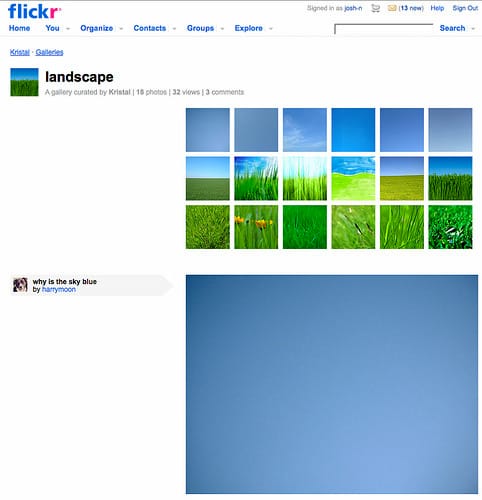
Flickr did something interesting when we launched Galleries. In effect, galleries are unique creations from other members’ original creative output. In a sense, it’s similar to the concept of repost on Tumblr, except you can now aggregate and repost multiple creative objects at once. Flickr is unique because it is a creative community that draws from the quality and breadth of contributions from its members. Sure, there are lots of content from everyone, but because of how the community is structured, there is a clear delineation between common objects and objects that members deem as ‘more than usual’ - through interestingness or views or other means of collection. An activity stream of equivalent data just won’t self-organize into the same nodes.
I’m curious to see how Galleries play out, whether it encourages members to create even more quality original objects. I hope so, especially since more and more we’ve become a culture of referencing, viz a viz dilution instead of originality.
Disclaimer: my own thoughts separate from the Flickr team’s thinking.